
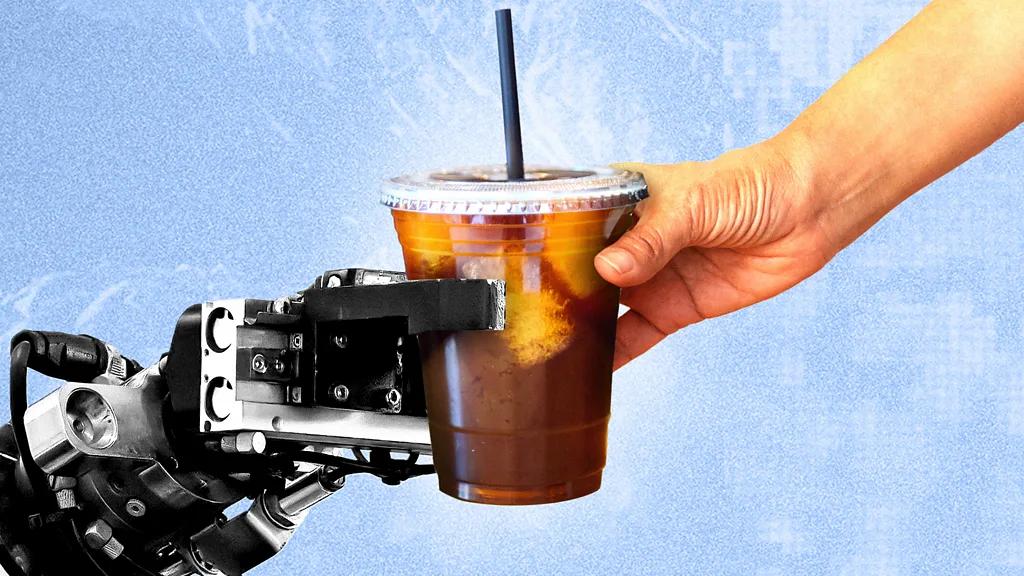
Robots Are Asking for Tips — But Who Actually Gets the Money?
Robots Are Asking for Tips — But Who Actually Gets the Money\
Machines are increasingly becoming part of the service industry, but a new question is emerging: Should customers tip a robot, and where does that money actually go?
At The Tipsy Robot bar inside Las Vegas’s Venetian Hotel, customers can watch robotic arms prepare cocktails. Select a drink such as a margarita on a touchscreen, and the machines spring into action, mixing tequila, lime and triple sec before presenting the finished drink.
The robotic performance may be entertaining, but the $17 cocktail comes with another surprise: a 10% service fee and an option to leave a tip.
It’s not an isolated example.
At Artly Coffee in New York, a robotic barista has also prompted customers to tip. At Newark Liberty International Airport, a self-service machine reportedly suggested adding a gratuity when customers bought a bottle of water from an unattended kiosk. Meanwhile, at Top Burmese in Portland, Oregon, customers can order from a human employee but have their food delivered by a robot.
For many customers, the question is no longer simply whether to tip, but who deserves the tip when a machine is performing part of the service?
Who gets a robot’s tip?
Representatives from The Tipsy Robot and Artly Coffee say tips collected through their robotic systems are distributed among human employees rather than kept by the companies.
Artly has since removed its automatic tip prompts following customer criticism, although some of its locations still have physical tip jars. The company says all tips continue to go to its human staff.
But labor experts warn that the situation could become more complicated as robotic technology spreads.
Holona Ochs, an associate professor of political science at Lehigh University and co-author of Gratuity, says there is currently no clear legal standard establishing who owns money tipped to a robot.
That uncertainty could create an opportunity for some employers to benefit from gratuities intended for service workers.
In traditional tipping arrangements in the US, federal law generally prevents employers, owners and supervisors from taking employees’ tips. But tipping a machine creates a new legal question: Does a tip given to a robot legally belong to a worker, the business or someone else?
America’s tipping culture is already changing
The debate over robot tipping comes as consumers are already facing more requests for gratuities.
Since the pandemic, digital payment systems have made tipping prompts common in restaurants, cafes, self-service locations and other businesses. Suggested percentages have also increased, leading some customers to complain that they feel pressured to tip.
The issue is particularly significant in the US, where tipped workers can legally receive a much lower federal minimum cash wage than most employees, provided their tips make up the difference required by law.
As automation becomes more common, some critics fear businesses could use robots while continuing to rely on tipping to support labor costs.
Robots don’t necessarily mean fewer jobs
Not everyone sees robotic service as a threat to workers.
Abigail Smathers, director of content at Artly Coffee, says the company’s robots are designed to work alongside people rather than simply replace them. She argues that the novelty of robotic coffee shops can itself create employment opportunities.
She also acknowledges that AI and automation can be used in situations where they may not be appropriate.
Her view is that the technology itself is neither inherently good nor bad. What matters is how businesses choose to implement it and who ultimately benefits.
Hospitality technology researcher Katerina Berezina of the University of Mississippi also cautions against assuming that every robot-related fee is simply a corporate attempt to make more money.
According to Berezina, service fees or tips could sometimes help cover the labor, maintenance and technological costs associated with operating robotic systems.
However, labor advocates such as One Fair Wage argue that automation may allow restaurants and other businesses to maintain low-wage models rather than addressing the underlying problems behind the industry’s labor shortages.
The customer has the final say
As robots become more visible in restaurants, cafes, hotels and other service businesses, customers may ultimately influence whether robot tipping becomes a permanent part of everyday life.
If people continue pressing the tip button, businesses have an incentive to keep offering it. If customers increasingly refuse to tip machines, companies may rethink the practice.
That leaves consumers with an increasingly unusual question at checkout:
When a robot serves you, are you tipping the machine, the worker behind it—or simply the company?
The answer could help determine what tipping looks like in the increasingly automated service industry of the future.


Solid platform with a great community vibe. It is always exciting to see who is winning today. I am really enjoying bdtak999.
The login process is quick and the security feels solid. I appreciate how straightforward everything is without too much clutter. Glad I found 11ccbetlogin.
The slots here are incredibly exciting and the graphics are amazing. I am winning big at megawinsslot
I’ve been looking for a stable platform and this one really delivers. The interface is smooth and the payouts are fast. Definitely check out winpkr2 if you want a reliable experience.
The download was super fast and the app installation was a breeze. It runs perfectly on my phone. Thanks for the easy setup indwin7download.
Top notch service and a great selection of options. It is refreshing to find a site that is this stable and responsive. br7gbet is definitely worth a visit.